Untch
Accounts payable for autonomous agents

The model never touches the money.

Give every agent a budget, a policy, a proof requirement, and a receipt trail. Untch checks every payment before it moves and anchors every decision on X Layer.
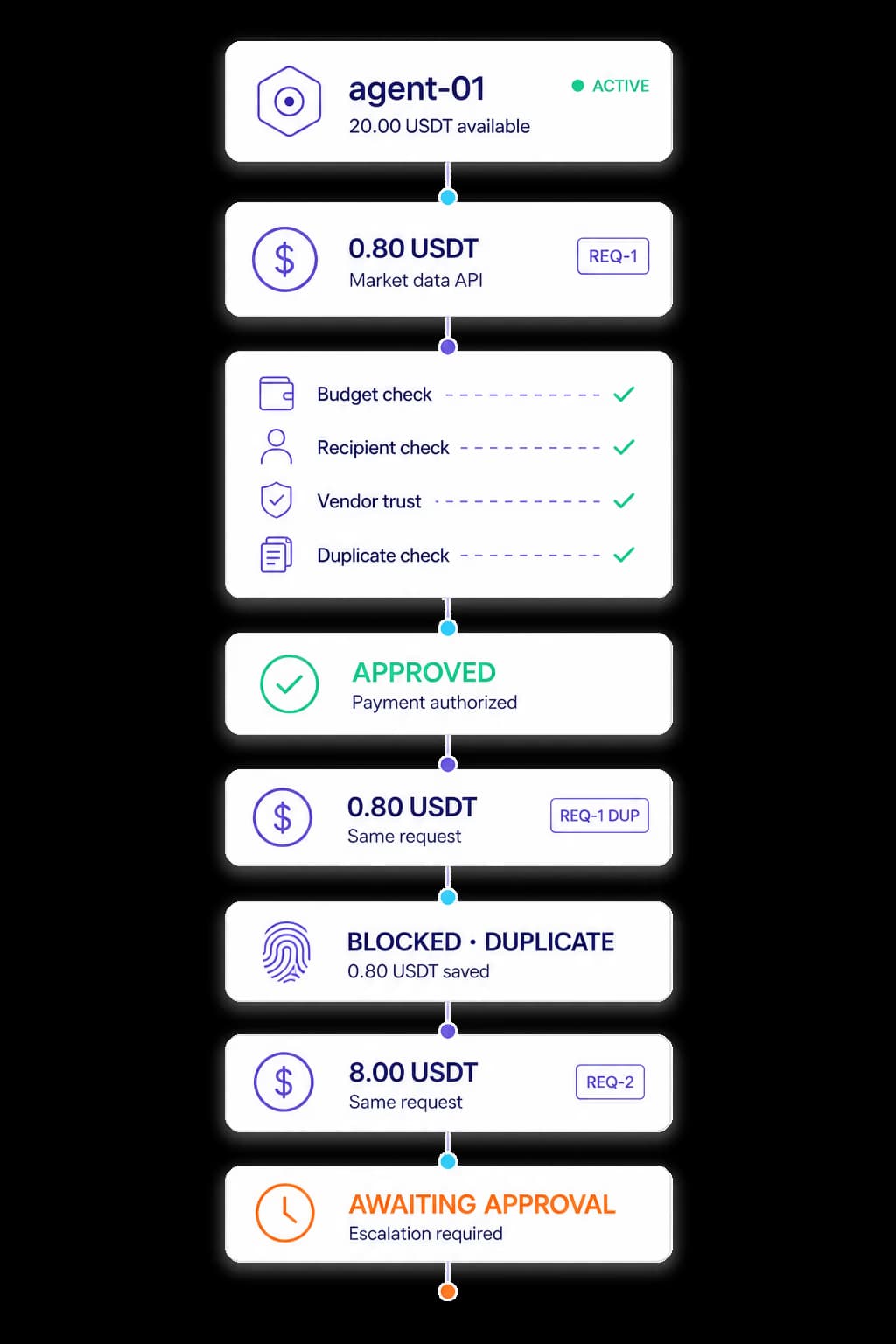
Untch decision flow: an agent's payments checked against policy, one approved, a duplicate blocked, and a larger one escalated for approval.
The gap

Paying is solved. Paying safely is not.

OKX solved the first part. An agent can discover services, call paid tools, and settle in stablecoins. But once an agent can spend, the operator funding it has no controls: no daily budget, no per-call cap, no allowlist, no duplicate protection, no approval threshold.

Hand an agent an unrestricted key and one prompt injection, hallucinated action, or runaway loop can drain it. The counterparty is opaque, a star rating with a tiny sample. And nothing checks that the delivery matched what was paid for. Untch closes that gap before a payment moves.

The loop

Bounded intent. Deterministic decision. Verifiable receipt.

01Bound the spendThe agent creates a canonical SpendIntent with a max amount, a deadline, and committed acceptance criteria. It cannot freestyle a payment because a model said so.
02Check before it movesThe policy engine evaluates the intent against budgets, caps, allowlists, duplicates, and vendor trust. Approve, block, or escalate. The decision is deterministic, and the model never touches it.
03Verify the deliveryOn delivery the proof engine runs the required tier: schema, signed trace, source hashes. Release is recommended only on a pass, with machine-readable evidence either way.
04Receipt on X LayerEvery decision and verification is anchored on-chain as a hash. Public proof, private payload. Blocks are receipted too, because a block is auditable value.
Every intent ends in one of:ApprovedBlockedEscalated
Four enforcement modes

From advice to physics.

Adopt in minutes and tighten as the stakes rise. The same policy governs every mode, so the control never changes, only how hard it is enforced.

AAdvisory MCPAdd the MCP server and a published system-prompt clause. The agent creates an intent and calls preflight before paying.Any framework, in minutes
BUntch GuardOpen-source x402 middleware. On a 402 challenge it runs the binding check and preflight before the agent signs. PII stripped pre-signature.One import
CUntch VaultFunds live in an on-chain vault. Only oracle-signed approvals within caps move them. Preflight becomes physics, and owner withdraw is unconditional.One deploy
DBroker GuardThe broker-side policy gate for APP flows. Holds challenge state, verifies credentials against the original request, and forwards only after a policy pass.Infrastructure-native
Live proof

Same intent. One variable.

The same market-data call, sent twice. The first is approved and receipted. The second is the identical task inside the duplicate window, so it is blocked and nothing moves. The difference lives entirely in the receipts.

Approved0.05 USDT
Ruleduplicate check passed
Resultpayment authorized
Receiptwritten on X Layer
vs
Blocked as duplicate0.05 USDT
Ruleduplicate in TTL window
Resultnothing moved
Receiptblock anchored on X Layer
View the real block receipt on OKLink →
Verify it yourself

Public proof. Private work. Accountable payment.

No testimonials. Untch is a working product, and its proof is on-chain. Every transaction below is real and opens on the X Layer explorer. Business payloads stay off-chain; only hashes are anchored.

I1The model never touches the money.Every approve, block, or escalate comes from deterministic policy evaluation. No LLM output sits in a money decision.
I2Fail closed.Any dependency failure during a preflight blocks or escalates the payment. It never silently approves.
I4The owner keeps custody.Untch's oracle key cannot withdraw or transfer funds. The owner can pause or withdraw without us.

Give your agent a budget and rules in minutes.

Add the policy, connect the agent, and every payment gets checked before it moves and receipted on X Layer.